
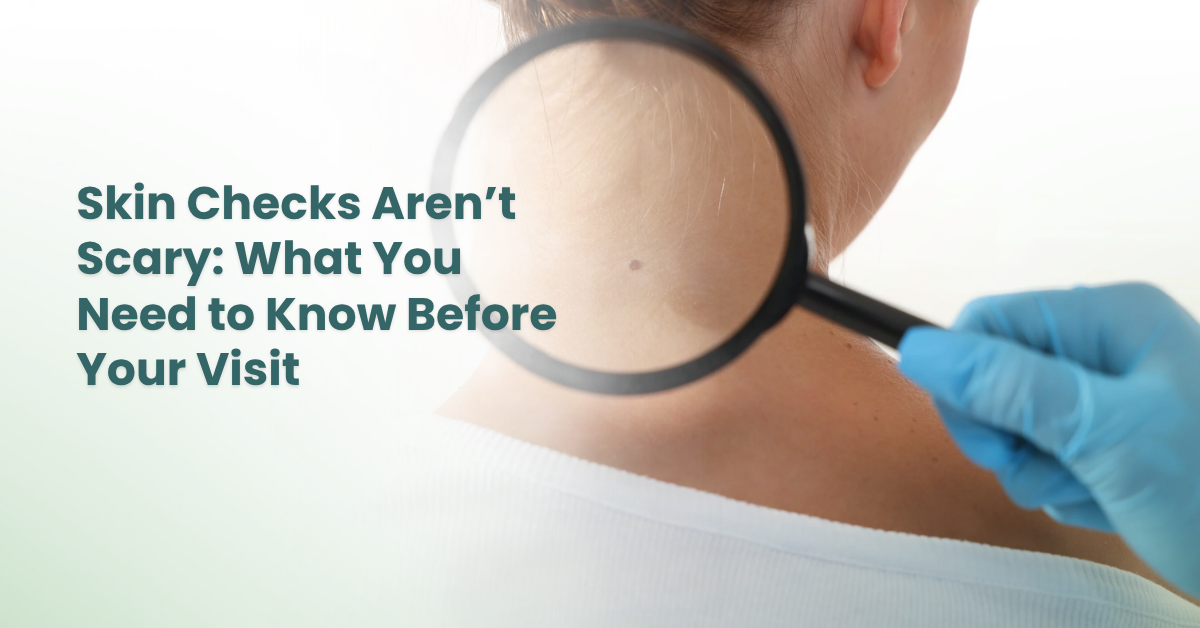
For some people, booking a skin check can feel intimidating. You may be worried that a mole looks unusual, unsure about what the doctor will examine, or concerned that the appointment will be uncomfortable.
In reality, skin checks are generally straightforward clinical examinations. Your GP looks carefully at your skin for spots or changes that may need closer assessment, while also considering factors that can influence your individual skin cancer risk.
Australia has high rates of skin cancer, making it particularly important to become familiar with your skin and seek medical advice when you notice something new or changing. Cancer Council Australia recommends seeing a doctor if you notice a new spot or changes in the size, shape or colour of an existing spot.
Knowing what happens during a skin examination can make your appointment feel much less daunting.
What Is a Skin Check?
A professional skin check is an examination performed by a doctor to look for suspicious lesions or other changes that could indicate skin cancer.
Depending on your reason for attending, the appointment may focus on one particular spot or involve a more comprehensive examination of your skin.
During a skin examination, your GP may assess:
- Moles
- Freckles
- Sunspots
- New or changing lesions
- Sores that are not healing
- Areas that itch, bleed or crust
- Spots that look different from the others on your body
Doctors may also use a dermatoscope a handheld magnifying instrument that allows them to examine structures within a skin lesion that are difficult to see with the naked eye.
Why Are Skin cancer Checks Important?
Skin cancer can sometimes develop without pain or other obvious symptoms. Cancer Council notes that skin cancers are much more frequently seen than felt, which is one reason becoming familiar with your own skin is important.
Early assessment matters because detecting skin cancer at an earlier stage can make treatment more straightforward and improve outcomes, particularly for melanoma.
A skin check does not mean your doctor expects to find cancer. It is simply an opportunity to investigate anything concerning and assess your individual risk.
Who Should Consider a Professional Skin Check?
Australia does not currently have a population-wide screening program recommending the same routine skin cancer screening schedule for every person. Instead, how often professional checks may be appropriate depends on individual risk.
You may benefit from discussing professional skin checks with your GP if you have:
- Fair skin that burns easily
- Red or fair hair
- Light-coloured eyes
- Significant lifetime sun exposure
- A history of frequent sunburn
- Many moles or unusual-looking moles
- A personal history of melanoma or another skin cancer
- A first-degree relative who has had melanoma
- A weakened immune system
- Regular occupational or recreational exposure to UV radiation
People who have previously had skin cancer may require ongoing surveillance at intervals recommended by their treating doctor.
Even without known risk factors, you should see your GP if you notice something on your skin that concerns you.
What Happens During a Skin Check?
Knowing what to expect can make the appointment considerably easier.
Your GP will usually begin by asking about your health and skin history. This may include questions about:
- Previous skin cancers
- Family history of melanoma or skin cancer
- Sun exposure
- Previous severe sunburn
- Changes you have noticed
- How long a particular spot has been present
- Whether a lesion has changed, bled, itched or become painful
If you have booked because of a particular mole or spot, show your doctor where it is and explain what has changed.
For a more comprehensive examination, your doctor may look across different areas of the body because skin cancers can occur in areas that receive little obvious sun exposure.
If you feel uncomfortable at any point, tell your doctor. You can ask questions about which areas need to be examined and why.
If you’d like to understand the process in more detail, read our guide on what happens during a skin check.
What Is a Dermatoscope?
A dermatoscope is a small handheld device containing magnification and a light source.
It allows a trained clinician to examine features within a mole or lesion in greater detail than is possible with the naked eye. Dermoscopy can improve diagnostic accuracy when used by appropriately trained clinicians.
Using a dermatoscope is generally painless. The doctor simply examines the area through the device, which may be placed close to or gently against the skin.
Not every spot examined with a dermatoscope will need treatment.
What Happens If the Doctor Finds Something?
Finding a suspicious spot does not automatically mean you have skin cancer.
Depending on what your GP sees, they may recommend:
- Monitoring the area for changes
- Taking clinical photographs for comparison
- Reviewing the spot again after a specified period
- Performing or arranging a biopsy
- Removing the lesion where clinically appropriate
- Referring you to a dermatologist or another specialist
A biopsy involves removing a small sample or sometimes the entire suspicious lesion so that it can be examined by a pathologist. Cancer Council notes that whether further testing is needed depends on the appearance and clinical assessment of the lesion.
Your doctor should explain why further investigation is recommended and what happens next.
What Skin Changes Should You Look For?
Between professional skin checks, getting to know what is normal for your skin can help you recognise changes.
One commonly used guide for monitoring moles is ABCDE:
A – Asymmetry: One half looks different from the other.
B – Border: The edges become irregular, blurred, ragged or uneven.
C – Colour: There are different colours or shades within the lesion.
D – Diameter: The spot is larger than approximately 6 mm or is increasing in size.
E – Evolving: The spot changes in size, shape, colour or another characteristic, including developing itching, bleeding or crusting.
ABCDE is useful, but it is not a diagnostic test. Not every melanoma follows these characteristics, and not every unusual-looking mole is cancerous.
Other warning signs can include a sore that does not heal, a spot that repeatedly bleeds or crusts, or a lesion that simply looks different from your other spots.
If something concerns you, have it assessed rather than waiting for it to meet every ABCDE criterion.
How Should You Prepare for a Skin cancer Check?
There is usually very little preparation required.
Before your appointment, it can help to:
- Make a note of any spots you want examined
- Think about when you first noticed them
- Note whether they have changed
- Bring previous skin photographs if you have them
- Know your personal and family history of skin cancer where possible
For a comprehensive skin examination, wearing clothing that is easy to remove can make the process simpler.
Avoid covering concerning spots with heavy makeup or cosmetic products immediately before your appointment where practical, as your doctor will need to see the skin clearly.
Most importantly, do not feel embarrassed about pointing out a spot simply because it seems minor. If you have noticed a change, tell your GP.
Can You Check Your Own Skin at Home?
Self-checking can be an important part of becoming familiar with your skin.
Cancer Council recommends checking your entire body, including areas that are easy to overlook, such as:
- Scalp
- Behind the ears
- Back
- Soles of the feet
- Between fingers and toes
- Under the nails
A full-length mirror and handheld mirror can help, or you can ask a partner or family member to check areas you cannot easily see.
Taking photographs can also help some people monitor changes over time, particularly when recommended as part of a higher-risk surveillance plan. Smartphone apps, however, should not be relied upon to diagnose skin cancer or replace assessment by a doctor.
Is a Skin Check Only for Moles?
No.
Although melanoma and changing moles receive considerable attention, doctors performing skin checks are also looking for other forms of skin cancer, including basal cell carcinoma (BCC) and squamous cell carcinoma (SCC).
Skin cancer can present in different ways, including:
- A new lump or spot
- A scaly or crusted area
- A sore that does not heal
- A lesion that repeatedly bleeds
- A changing mole
- A spot that looks noticeably different from surrounding spots
This is why looking at changes across your skin, not only dark moles, is important.
What About Rashes and Other Skin Concerns?
Not every skin concern is related to cancer.
A GP can also assess many common skin problems, including rashes, dermatitis, eczema, acne, infections and unexplained itching.
If you are searching for a skin rash doctor because a rash is persistent, worsening, painful, spreading or repeatedly returning, a GP is a useful first point of contact. Depending on the findings, treatment may be provided in general practice or referral to a dermatologist may be recommended.
A rash that develops alongside severe symptoms such as breathing difficulty or swelling of the face or tongue requires urgent medical attention.
How Often Should You Have a Skin Check?
There is no single skin-check interval that is appropriate for every Australian.
Cancer Council Australia does not recommend population-based melanoma screening for everyone because there is currently insufficient evidence to support a universal screening program. Instead, professional examination should be based on individual risk and concerning skin changes.
People at higher risk may be advised to have regular professional examinations. Cancer Council notes that high-risk individuals may benefit from six-monthly full skin examinations supported by dermoscopy and total-body photography.
Your GP can assess your personal risk and recommend an appropriate schedule.
FAQs
Are skin checks painful?
The examination itself is generally painless. Your doctor visually examines the skin and may use a dermatoscope. If a biopsy or removal is recommended, your doctor will explain the procedure and pain-management options beforehand.
Do I need a skin check if I have no suspicious moles?
Not everyone requires routine professional screening at the same interval. Your GP can assess your risk based on factors such as skin type, sun exposure, number of moles, family history and previous skin cancer.
Can a GP perform a skin check?
Yes. GPs can examine suspicious lesions and assess skin cancer risk. Depending on the findings and your risk profile, they may manage the concern themselves or refer you to a dermatologist.
Should I worry about a mole that has changed?
A new or changing mole should be assessed by a doctor. Changes in size, shape or colour, or symptoms such as bleeding or itching, are reasons to arrange an assessment.
Can skin cancer occur somewhere that does not get much sun?
Yes. Skin cancer, including melanoma, can occur on areas that are not routinely exposed to sunlight, which is why checking the whole body is important.
What should I do if I find a new spot?
If a spot is new, changing or looks different from the other spots on your body, arrange an appointment with your GP rather than attempting to diagnose it yourself.
Discuss Your Skin Concerns With a GP
If you are concerned about a new or changing spot, unusual mole, or other skin change, speaking with your GP can help you understand whether further assessment is needed. Botanic Ridge Doctors provides general practice care for patients with a range of health concerns, including skin-related concerns.
The Bottom Line
Skin checks do not need to be frightening. For most people, the appointment is a straightforward opportunity to have concerning spots examined, understand individual skin cancer risk and determine whether anything requires monitoring or further investigation.
Get to know what is normal for your skin and pay attention to anything new or changing. If a mole changes in size, shape or colour, a sore does not heal, or a spot simply concerns you, speak with your GP.
You do not need to decide whether something “looks like cancer” before making an appointment that assessment is exactly what your doctor is there to help with.
References